EHDS Governance Models
Publication date: May 06, 2026
What's the EHDS governance model as documented in the regulation? Understanding that model will help to understand the EHDS itself.
Whilst developing the content for our new EHDS-on-FHIR training course
(aimed at EHDS implementers) I found a need to include some slides on the EHDS governance model. Although not implementation-oriented the governance model
provides context for content of the EHDS regulation.
EHDS Governance
The EHDS regulation documents the various governance roles. Initially I tried to create one single governance model for the entire scope of the EHDS,
but that turned out to be impractical - the governance model for primary differs significantly from that of secondary use.
Let's start by looking at the governance mode for primary use.
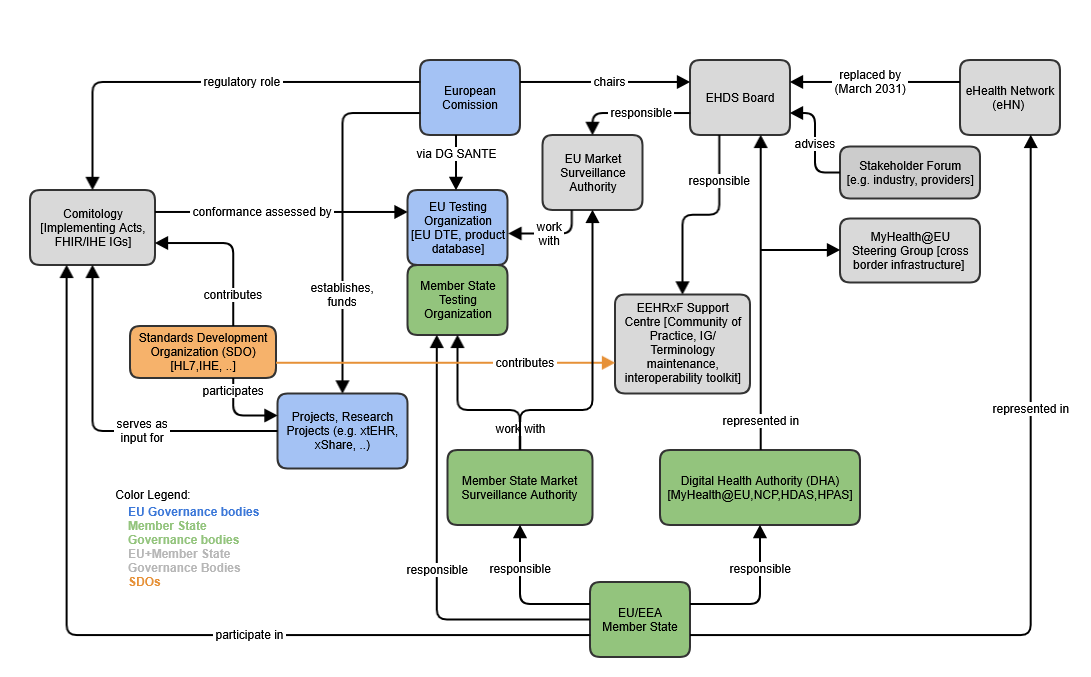
EHDS Governance - Primary Use
Key roles include:
- Member States (EU/EEA members, shown in green), the European Comission (shown in blue) and the EHDS Board (shown in grey, controlled jointly by the EC and the member states).
- The left hand side of the diagram depicts the comitology process whereby the comission and the meber states create implementing acts.
Implementing acts are used to specify implementation details of the regulation. Implementing acts will be defined up to the initial EHDS deadline of March 2029, as well as after that date.
- The Digital Health Authority (DHA) has the responsibility to establish the MyHealth@EU infrastructure and the National Contact Point (NCP).
All governance roles shown in green are to be set up by member states - are you aware which (new) organisations will be playing these roles ?
Most member states are still in the process of defining which organisations will be involved.
The governance model for secondary use looks quite different.
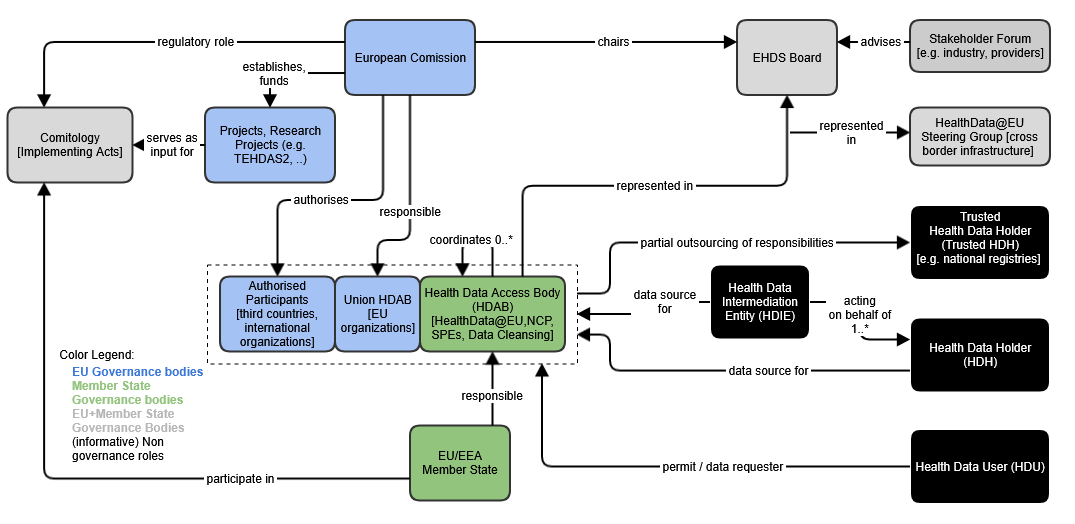
EHDS Governance - Secondary Use
Key roles include:
- Member States (EU/EEA members, shown in green), the European Comission (shown in blue) and the EHDS Board (shown in grey, controlled jointly by the EC and the member states).
- The left hand side of the diagram depicts the comitology process whereby the comission and the meber states create implementing acts.
Implementing acts are used to specify implementation details of the regulation. Implementing acts will be defined up to the initial EHDS deadline of March 2029, as well as after that date.
- The Health Data Access Body (HDAB), one or more per member state, has the responsibility to establish the HealthData@EU infrastructure and the National Contact Point (NCP).
The Union HDAB and the 'Authorised Participants' are efectively a special category of HDAB.
- The roles shown in black identify the data users and data holders.
'All models are wrong, but some are useful" (attributed to George Box) - I'm sure these models are incomplete in places, but they'll serve us well as part of the EHDS training course.
-Rene
PermaLink to this page: https://www.ringholm.com/column/ehds-governance-model-primary-secondary-use.htm
Index of columns:
- EHDS questions from the Rotterdam HL7 Meeting (May 26, 2026)
- EHDS Governance Models (May 06, 2026)
- Get ready for EHDS implementation - EHDS-on-FHIR training course (Apr 10, 2026)
- EHDS will have an impact well before 2029 (Feb 13, 2026)
- EHDS checklist for application vendors and provider organizations (Nov 11, 2025)
- New EHDS-on-FHIR training course (Oct 26, 2025)
- Gender Identity in Interoperability Standards (Aug 25, 2025)
- FHIR and Narrative content (Jun 11, 2025)
- 6 Rules for Successful Interoperability Projects (Feb 13, 2025)
- Deploying FHIR at Scale (Dec 18, 2024)
- 9 Key Problems When Connecting to 400+ Servers (Sep 25, 2024)
- FHIR for HL7v2 experts (Aug 18, 2023)
- The FHIR open license (Feb 18, 2022)
- Bye bye IHE XDS and CDA. (Sep 01, 2021)
- Combining the best of IHE XDS with HL7 FHIR (Jun 27, 2019)
- FHIR DevDays and the year in review (Dec 27, 2018)
- Creation and Curation of FHIR Profiles - process and governance (Dec 14, 2017)
- Impact of the GDPR on the use of interoperability standards (Jun 27, 2017)
- Next XDS Release (Oct 27, 2016)
- Five years of FHIR (Aug 11, 2016)
- Update from the trenches on CDA R2.1/R3 and HL7v2. (Oct 15, 2015)
- Most often implemented IHE Profiles (Jun 08, 2015)
- Mapping HL7v2 messages to FHIR. (Apr 13, 2015)
- Recent and Future developments of the DICOM standard (Mar 06, 2014)
- Documenting the history of HL7 (Sep 03, 2013)
- Interoperability Standards - the no-sales pitch (Jul 09, 2013)
- CDA Implementation Guides - (not) invented here (Apr 17, 2013)
- Usage of IHE Profiles (Feb 25, 2013)
- 10 year anniversary - Dutch Ringholm HL7 v2 training courses. (Feb 19, 2013)
- HL7 Connectathons (Sep 09, 2012)
- Frequency of use of HL7 message types (Jul 24, 2012)
- Reflections on the HL7 membership model - the affiliate life cycle (Dec 28, 2011)
- RFH (Resources for Health): HL7 version 3 taken to the next step (Aug 18, 2011)
- Timezone Hotel (Mar 29, 2011)
- The changing role of HL7 country organizations (Jul 16, 2010)
- How to lower the hurdle for HL7 v3 implementers (Jan 21, 2010)
- The HL7 roadmap for CDA R3 and the CCD (Jan 17, 2009)
- HL7 based Tree inventory system (Jan 30, 2007)
- Workflow Bribery (Sep 15, 2006)

About Ringholm bv
Ringholm bv is a group of European experts in the field of messaging standards and systems integration in healthcare IT.
We provide the industry's most advanced training courses and consulting on healthcare information exchange standards.
See https://www.ringholm.com for additional information.
|
 Rene is the Tutor-in-chief of Ringholm.
[e-mail]
|


